 Leie Life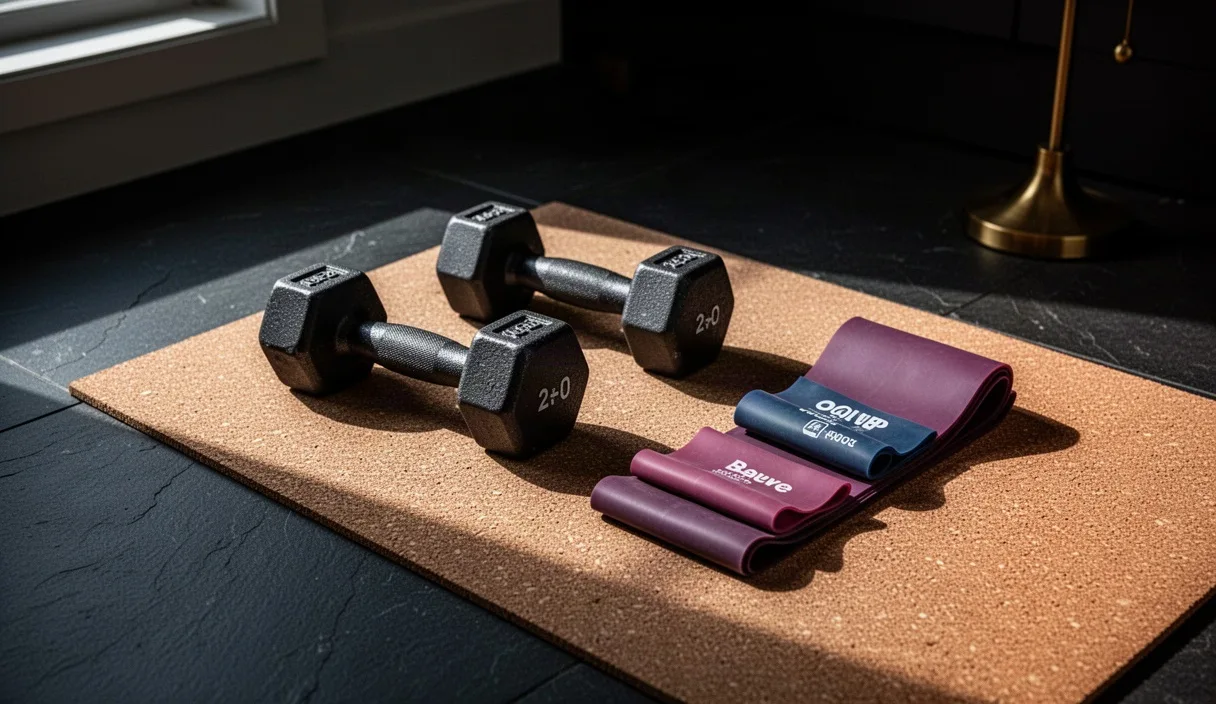

As the autumn fog settles low over the Leie and the rowers pack away their sculls in Deinze or Kortrijk, daily routines shift indoors. For those of us past forty-five, staying active often means deciding what kind of kit belongs in the spare bedroom or garden shed. Walking the damp towpaths or cycling against a headwind provides plenty of cardiovascular stamina, but bone architecture demands a fundamentally different physical stimulus once the fifth decade arrives. Mineral density declines steadily without targeted mechanical strain, making deliberate strength work an unavoidable necessity rather than a hobby.
The practical question usually comes down to equipment. A set of cast-iron hex dumbbells takes up floor space and can ding hardwood floors, while a pack of woven or latex resistance bands slips neatly into a bedside drawer. Both tools claim to preserve bone and protect ageing joints, yet they communicate with the skeleton through distinct physical pathways. Deciding between iron and elastic tension requires a look at how mineral tissue responds to load, how joints tolerate strain, and how consistent training actually fits into a Flemish terraced house or an apartment along the water.
Bone Remodeling Mechanics in Mature Adulthood
Bone is dynamic living tissue that reacts to stress according to Wolff's Law: tissue adapts to the loads placed upon it. Two primary cell types govern this architecture: osteoclasts, which resorb old or damaged mineral matrix, and osteoblasts, which lay down fresh hydroxyapatite and collagen scaffold. In early adulthood, synthesis roughly matches or exceeds breakdown. After the age of forty-five, hormonal shifts, including drops in circulating estrogen during menopause and gradual reductions in natural vitality, tilt the balance toward osteoclast activity. In sedentary adults, this uncoupling can cause an annual bone mineral density decline between 0.8 percent and 1.6 percent, targeting the lumbar spine and the femoral neck most aggressively.
To prompt an osteoblast into building mineral deposits, a training stimulus must exceed the habitual threshold, a concept researchers call the minimum effective strain. Everyday walking or light cycling along flat tarmac rarely triggers this process because the skeletal strain remains below the roughly 1,000 to 1,500 microstrain necessary to signal mechanotransduction. When mechanocytes within the bone matrix deform under load, fluid moves through tiny canaliculi, generating fluid shear stress. This physical current stimulates biochemical signals, primarily prostaglandin E2 and nitric oxide, which call osteoblasts to the stressed site.
The speed and vector of the load matter as much as the weight itself. Bone adapts preferentially to high-rate strains and novel directional vectors. A repetitive, predictable movement done thousands of times generates less structural adaptation than a short set of focused movements that apply sudden or heavy compressive forces. If you want to keep the hips and vertebrae sturdy enough to handle sudden slips on wet cobbles, the skeleton needs deliberate, multi-directional stress rather than passive endurance alone.
How Free Weights Apply Axial Bone Loading
Free weights, whether kettlebells, dumbbells, or barbells, rely entirely on gravity. Because gravity pulls directly downward toward the floor, free weights provide axial loading, a direct compressive force that travels down the spine, through the pelvis, and straight through the femur to the ground. A goblet squat with a twelve-kilogram dumbbell held against the sternum forces the lumbar vertebrae and the hip joints to stabilize under external compression. This axial force causes the exact micro-deformation needed to trigger bone mineral deposition in the femoral neck.
Free weights also maintain a consistent resistance curve throughout the entire range of motion. Twelve kilograms at the bottom of a Romanian deadlift remains twelve kilograms at the top. In fact, due to leverage and moment arms, the muscular and skeletal torque is often greatest in the stretched position where bones and tendons interface. This high mechanical tension near the floor creates significant ground reaction force, transmitting energy upward from the feet and demanding strong calcaneal, tibial, and femoral remodeling.
The key movements for axial skeletal loading include:
- The Goblet Squat: Compresses the lumbar spine and femoral neck while teaching deep ankle dorsiflexion.
- The Romanian Deadlift: Directs tension through the posterior chain, stimulating the posterior hip capsule, sacrum, and lower spinal active vitality.
- The Standing Overhead Press: Delivers true vertical compression through the cervical and thoracic spine down into the pelvic ring.
- The Farmer's Walk: Combines compressive spinal load with micro-impact steps, forcing lateral hip stabilizers to react to ground shock.
Free weights present a mechanical trade-off: gravity does not forgive a loss of balance. If a weight gets away from you during an overhead movement, the risk of acute spinal or shoulder strain increases, especially for individuals dealing with mild joint mobility or rotator cuff fraying. Technique must remain clean, measured, and conservative.
Where Elastic Bands Excel for Tendon Safety
Resistance bands work on Hooke's Law rather than gravitational acceleration: the restoring force is proportional to the distance the elastic material is stretched. At the bottom of a band-resisted squat, when the hips are low and knees are flexed, the band is under minimal tension. As you stand upward into your strongest mechanical position, the band elongates, increasing tension steadily until lockout. This progressive curve, known as accommodating resistance, removes peak joint strain from vulnerable, deep angles where cartilage wear or impingement usually hurts most.
This dynamic profile makes elastic bands gentle on connective tissue, particularly where tendons insert into bone, known as the enthesis. As we pass forty-five, tendons lose water content and elasticity, making them prone to insertional tendinopathy under heavy, unyielding iron loads. Bands allow the user to produce high muscular contractions at the top of an exercise without subjecting stiff knees, shoulders, or hips to sudden, jarring eccentric forces. The tension drops automatically the moment you return to the starting position.
Where bands fall short, however, is pure axial skeletal loading. A band looped under the feet and held at the shoulders provides ascending tension, but it lacks the direct gravitational mass that drives continuous compression through the skeleton. While bands pull the muscles hard, generating tensile strain across the cortical bone where muscles attach, they deliver less compressive fluid shear stress to the femoral neck and lumbar spine than a solid cast-iron bell. Bands excel at targeting rotational, lateral, and pulling planes that fortify the shoulder girdle, middle back, and hip abductors without grinding irritated joints.
Cost, Storage, and Injury Risk Compared
Equipping a home for physical training requires balancing square metres, budget, and safety. A townhouse in central Ghent with steep wooden stairs does not welcome fifty kilograms of cast iron being lugged up to the attic. At the same time, flimsy elastic loops that snap during a row create their own hazards.
| Factor | Free Weights (Dumbbells/Kettlebells) | Resistance Bands (Loop & Tube) |
|---|---|---|
| Estimated Cost | Around 2.50 to 3.80 euros per kilogram; full set runs 160 to 320 euros. | A set of four layered latex loop bands runs 35 to 65 euros. |
| Storage Footprint | Requires sturdy floor space, rubber mats, or dedicated rack. | Fits in a small tote bag; stores in any cupboard or drawer. |
| Axial Bone Stimulus | High; gravitational mass directly compresses long bones and spine. | Moderate; creates tensile muscle pull but lower direct axial mass. |
| Joint Shear Hazard | High if form breaks down at end ranges or during heavy lifts. | Low; resistance eases off at the deepest, most vulnerable angles. |
| Common Failure Mode | Dropped bells causing toe, foot, or flooring damage; back strain. | Latex snapping, skin pinching, or bands slipping off footwear. |
For most lifters past forty-five, the sweet spot lies in a thoughtful combination rather than strict loyalty to one tool. Free weights handle primary compressive movements like squats and carries where high mass yields dense bone. Elastic bands handle rotator cuff preservation, lateral hip stability, and pulling variations where high joint friction or poor posture makes heavy iron awkward and risky.
A Sample Weekly Home Strength Framework
Consistency trumps intensity every week of the year. Three thirty-minute sessions per week provide enough rest between workouts for recovery while still giving the skeletal system the regular stress it needs to signal osteoblasts. Keep a solid wooden chair, a flat doorway, a small floor mat, a pair of moderate dumbbells (such as 6 to 10 kilograms), and a couple of looped latex bands nearby.
Session A: Tuesday (Compressive Foundation)
- Warm-up joint circles: Three minutes of deliberate ankle rolls, hip openers, and cat-cow stretches on the rug to lubricate synovial joints.
- Goblet squat: Hold one dumbbell vertically against the chest. Lower slowly for three seconds until thighs are parallel to the floor, then stand firmly. Perform 4 sets of 8 repetitions. Rest 75 seconds between sets.
- Band-resisted horizontal row: Anchor a medium loop band around a sturdy banister or closed door frame at chest height. Pull both elbows back, pinching shoulder blades together. Perform 3 sets of 12 repetitions with a two-second pause at full squeeze.
- Suitcase carry: Pick up one dumbbell in your right hand. Walk with an upright torso for 35 paces across the living room or hallway, avoiding any leaning. Switch to the left hand and repeat. Complete 3 sets per side.
Session B: Thursday (Posterior Chain and Lateral Stability)
- Warm-up hip hinges: Two minutes of unweighted good-mornings, pushing hips back to feel the hamstring stretch without rounding the spine.
- Dumbbell Romanian deadlift: Hold a dumbbell in each hand in front of the thighs. Soften the knees and push the hips backward toward the wall behind you, lowering the weights to just below knee level. Squeeze the glutes to stand tall. Perform 4 sets of 8 repetitions.
- Lateral band walks: Place a mini-band around your calves or just above the knees. Drop into a quarter squat and step sideways across the room for 12 paces, then return. Complete 3 rounds.
- Overhead dumbbell carry: Press a single moderate dumbbell overhead with an extended arm. Keep ribs pinned down and walk 25 paces. Switch arms. Complete 3 sets per side to challenge thoracic spine bone density.
Session C: Saturday (Accommodating Tension and Rotational Force)
- Band-assisted push-up: Loop a light band around your upper back and under your hands, or place hands on a sturdy kitchen table edge to adjust leverage. Perform 3 sets of 8 to 10 clean repetitions.
- Single-leg dumbbell step-up: Step onto a sturdy, low wooden step or low stool, holding light dumbbells. Drive through the heel to stand, controlling the descent for three seconds. Complete 3 sets of 6 repetitions per leg.
- Band Paloff press: Anchor a band at solar plexus height. Stand perpendicular to the anchor, hold the band with both hands at your chest, and press straight out, resisting the twist. Hold for three seconds; complete 3 sets of 10 repetitions per side.
Common Mistakes to Avoid
The most frequent training misstep among mature adults is treating strength workouts like cardiovascular endurance. Pumping light one-kilogram pink neoprene dumbbells for thirty repetitions builds muscular endurance and burns a few calories, but it produces insufficient mechanical strain to prompt osteoblasts into laying down new bone. Bone responds to intensity and mechanical load, not the mild burn of light repetition work. If you can easily complete fifteen repetitions of a movement without slowing down, the load is too light to support skeletal remodeling.
Another common mistake is failing to secure resistance bands properly. Looping an elastic band under smooth leather-soled shoes or around a flimsy chair leg leads to sudden snaps, bruised shins, or facial hits. Always step into bands wearing grippy rubber-soled shoes, and secure them exclusively around structural anchors, such as solid wood balustrades or closed, locked doors fitted with proper door anchors. Check your bands monthly under good light: look for tiny white stress marks or small tears near the edges, and replace damaged bands immediately.
Finally, avoid rushing through the lowering portion of each exercise. The eccentric phase, when the weight lowers or the band returns toward its anchor, generates significant muscular micro-tension that translates directly into skeletal remodeling. Dropping weights down quickly or letting the band yank your hands back deprives the bones of nearly half the adaptation stimulus while throwing sudden, uncontrolled shock directly into the tendon attachments.
Moving Forward Safely
Before introducing external resistance to your weekly routine, consult your general practitioner or physical therapist, especially if you have a prior diagnosis of osteopenia, cellular vitality, or past joint replacements. A simple dual-energy x-ray absorptiometry (DEXA) scan provides an objective baseline of your T-scores at the hip and lumbar spine. Knowing those numbers helps your clinician point out which movements, such as heavy loaded spinal flexion, should be modified or avoided entirely.
Once you have medical clearance, start quietly. Clear a three-metre square space on the floor, invest in a single moderate weight and a reliable set of layered latex bands, and anchor the habit into your calendar just like your trips to the local bakery or weekly chores. Bones take roughly four to eight months of steady, progressive loading to show measurable remodeling on mineral scans. The reward for your patience is not merely a number on a chart: it is the quiet confidence that your frame can absorb a sudden slip on wet cobblestones, carry heavy boxes up the stairs, and keep you moving freely for decades to come.